
ERP Integration for AI Agents: Unlocking SAP, Oracle, and NetSuite for Intelligent Automation
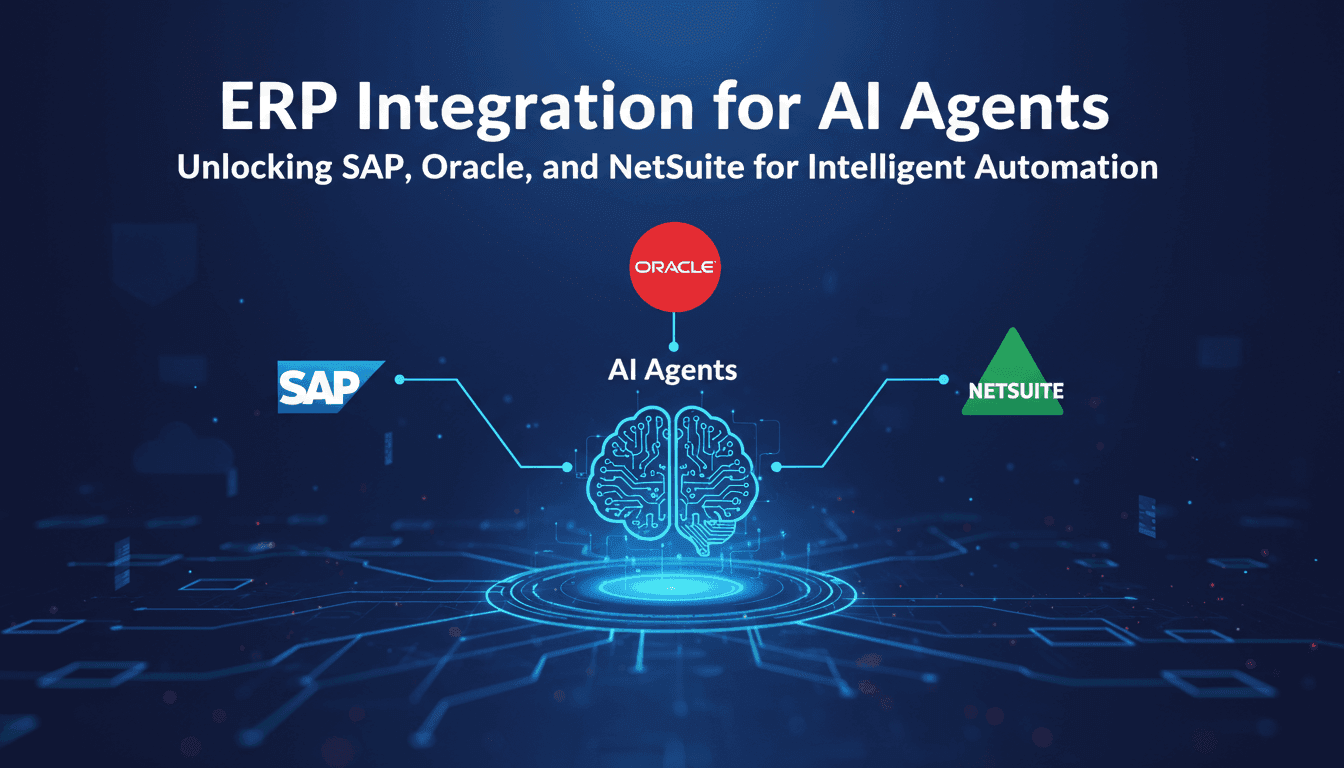
Table Of Contents
- Why AI Agents Need ERP Integration
- Understanding the Integration Landscape
- SAP Integration for AI Agents
- Oracle ERP and AI Agent Integration
- NetSuite Integration Strategies
- Common Integration Challenges and Solutions
- Building Your Integration Roadmap
- ROI and Business Impact
The convergence of artificial intelligence and enterprise resource planning systems represents one of the most significant shifts in how organizations operate. While many companies have invested heavily in both ERP platforms and AI initiatives, the true value emerges only when these systems communicate seamlessly. AI agents that can access, interpret, and act upon ERP data transform from interesting experiments into powerful business tools that drive measurable outcomes.
For Singapore-based enterprises and organizations across the Asia-Pacific region, integrating AI agents with established ERP systems like SAP, Oracle, and NetSuite isn't simply a technical exercise. It's a strategic imperative that determines whether AI investments deliver tangible returns or remain isolated proof-of-concepts. The challenge lies not in the potential value, which is substantial, but in navigating the complex integration landscape with clarity and purpose.
This guide examines how leading organizations are successfully connecting AI agents to their ERP systems, the specific considerations for each major platform, and the practical steps required to move from AI experimentation to operational impact. Whether you're evaluating integration options or refining an existing implementation, understanding these platform-specific approaches helps ensure your AI initiatives generate real business gains.
Why AI Agents Need ERP Integration
Enterprise resource planning systems function as the operational backbone for most organizations, housing critical data across finance, supply chain, human resources, manufacturing, and customer relationships. When AI agents operate in isolation from these systems, they lack the contextual information necessary to make informed decisions or take meaningful actions. An AI agent that cannot access current inventory levels, outstanding invoices, or production schedules operates with fundamental blind spots that limit its effectiveness.
The integration between AI agents and ERP systems creates what industry analysts call "operational intelligence." This goes beyond traditional business intelligence by enabling systems to not only analyze data but also execute actions based on that analysis. An AI agent integrated with your ERP can identify a supply chain disruption, assess inventory across multiple locations, recommend optimal reallocation strategies, and initiate the necessary transfer orders—all without human intervention for routine scenarios.
For decision-makers evaluating these integrations, the business case centers on three core benefits. First, AI agents with ERP access dramatically reduce response times for critical business events, often from hours or days to minutes. Second, they unlock insights hidden in the massive data volumes that ERP systems accumulate, identifying patterns that human analysts would miss. Third, they enable automation of complex, multi-step processes that previously required human judgment at multiple decision points. Organizations attending Business+AI workshops consistently report that ERP integration represents the tipping point where AI moves from interesting to indispensable.
Understanding the Integration Landscape
Before examining platform-specific approaches, understanding the broader integration landscape helps frame your strategy. Modern ERP-AI integrations typically follow one of three architectural patterns, each with distinct advantages and implementation considerations.
API-based integration represents the most common approach, leveraging the REST or SOAP APIs that modern ERP systems expose. This method offers clean separation between systems, maintains security boundaries, and allows AI agents to access specific data and functions without deep system coupling. The challenge lies in API limitations—not all ERP functions are exposed through APIs, and rate limiting can constrain real-time applications.
Database-level integration provides AI agents with direct access to ERP database structures, enabling comprehensive data extraction and complex queries that APIs might not support. This approach delivers superior performance for data-intensive AI applications and eliminates API throttling concerns. However, it requires careful management of database connections, introduces tighter coupling between systems, and may complicate ERP upgrades if AI agents depend on specific database schemas.
Middleware-based integration employs specialized integration platforms that sit between AI agents and ERP systems, translating requests and managing data flow. This approach excels when integrating multiple systems, provides robust error handling and logging, and can aggregate data from various sources. The tradeoff involves additional infrastructure complexity and potential latency from the extra system layer.
Your choice among these patterns depends on factors including real-time requirements, data volume, existing IT architecture, and internal technical capabilities. Many organizations ultimately implement hybrid approaches, using APIs for transactional operations while employing database integration for analytical workloads.
SAP Integration for AI Agents
SAP's enterprise software ecosystem, particularly S/4HANA and its cloud variants, presents both opportunities and complexities for AI integration. As the world's leading ERP provider with particularly strong penetration in manufacturing and large enterprises, SAP has evolved its integration capabilities significantly in recent years.
Key Integration Points
SAP's integration strategy centers on several key technologies that AI developers should understand. The SAP Business Technology Platform (BTP) provides a comprehensive environment for building extensions and integrations, including AI agents that interact with SAP data. BTP includes pre-built connectors, development tools, and services specifically designed to bridge external applications with SAP systems.
For AI agents requiring real-time data access, SAP Gateway and OData services expose SAP functionality through RESTful APIs. This approach works well for AI agents that need to query master data, check document statuses, or initiate workflows. The OData standard provides a consistent query language across different SAP modules, simplifying development when your AI agents need to access data from multiple SAP components.
RFC (Remote Function Call) integration remains relevant for organizations running classic SAP ECC systems or requiring access to functions not yet exposed through modern APIs. While RFC represents older technology, it provides comprehensive access to SAP business logic and can support sophisticated AI agent interactions when properly implemented.
The emergence of SAP Cloud Connector addresses a critical need for hybrid deployments where AI agents run in cloud environments but must access on-premises SAP systems. This secure tunneling solution enables cloud-based AI agents to interact with SAP systems behind corporate firewalls without exposing those systems directly to the internet.
SAP's Native AI Capabilities
Organizations should also consider SAP's embedded AI capabilities when planning integrations. SAP has incorporated machine learning into many standard processes through its Business AI framework, covering areas like cash application, invoice processing, and demand forecasting. Understanding these native capabilities helps avoid duplicating functionality and identifies where custom AI agents add incremental value.
The strategic question for SAP users often isn't whether to use AI with their ERP, but rather how to balance SAP's embedded AI with custom agents that address organization-specific needs. Business+AI consulting services help organizations navigate this decision by assessing which processes benefit most from custom AI development versus configuration of SAP's native capabilities.
Oracle ERP and AI Agent Integration
Oracle's cloud-first ERP strategy, embodied in Oracle Cloud ERP (formerly Fusion Applications), provides a different integration landscape compared to SAP. Oracle's approach emphasizes cloud-native architecture with extensive integration capabilities built into the platform foundation.
Oracle's Integration Architecture
Oracle Integration Cloud (OIC) serves as the primary integration hub for connecting AI agents with Oracle ERP systems. OIC provides pre-built adapters for Oracle applications, visual mapping tools, and comprehensive monitoring capabilities. For AI developers, OIC's REST adapter enables custom AI agents to interact with Oracle ERP through standardized interfaces without requiring deep Oracle expertise.
The REST APIs that Oracle exposes for its cloud applications are notably comprehensive, covering most business objects and processes. Oracle's API documentation is generally well-structured, and the consistency across different modules reduces integration complexity. AI agents can perform complex operations like creating sales orders, updating project statuses, or querying financial data through these APIs with relatively straightforward implementations.
For organizations requiring real-time event-driven architectures, Oracle's Business Events framework allows AI agents to subscribe to specific ERP events. When particular conditions occur in the ERP system—such as a purchase order approval, inventory falling below threshold, or a customer payment—the system can trigger notifications that AI agents consume and act upon immediately.
Oracle Autonomous Database, often used alongside Oracle Cloud ERP, provides AI and machine learning capabilities at the database layer. This creates interesting architectural possibilities where some AI processing occurs within the database itself, reducing data movement and improving performance for certain use cases.
AI-Ready Features in Oracle Cloud
Oracle has embedded AI capabilities across its cloud applications through Oracle Adaptive Intelligent Apps. These include predictive analytics for financial planning, intelligent process automation for procurement, and recommendation engines for various workflows. When designing AI agent integrations, understanding these embedded capabilities helps identify complementary opportunities rather than redundant implementations.
The Oracle Analytics Cloud provides another integration point for AI agents focused on decision support rather than transaction automation. AI agents can leverage Oracle Analytics' semantic layer to access curated, business-friendly data definitions rather than working directly with raw database structures.
NetSuite Integration Strategies
NetSuite, Oracle's cloud-based ERP solution targeting mid-market companies, offers distinct integration approaches that reflect its unified cloud architecture and strong presence among growing businesses and subsidiaries of larger organizations.
SuiteCloud Platform Advantages
The SuiteCloud Platform represents NetSuite's comprehensive development and integration environment. For AI agent integration, SuiteCloud provides multiple pathways depending on integration requirements and technical preferences.
SuiteScript enables custom logic directly within NetSuite, written in JavaScript. AI agents can trigger SuiteScript functions through RESTlets (custom REST endpoints), allowing sophisticated operations that leverage NetSuite's business logic while maintaining system consistency. This approach works particularly well when AI agents need to perform multi-step operations that should execute as atomic transactions.
SuiteTalk Web Services provide SOAP-based integration with comprehensive access to NetSuite data and functionality. While SOAP is considered less modern than REST, SuiteTalk offers mature, stable integration that many enterprise integration platforms support well. For AI agents handling complex data structures or requiring robust error handling, SuiteTalk remains a viable choice.
The newer RESTlet framework offers REST-style integration that many developers find more intuitive than SOAP-based approaches. RESTlets allow AI agents to interact with NetSuite using JSON payloads and standard HTTP methods, simplifying integration for modern AI development frameworks.
Real-Time Data Access for AI
One of NetSuite's advantages for AI integration comes from its unified data model. Unlike ERP systems that evolved through acquisitions and have separate databases for different modules, NetSuite maintains a single database for all business data. This architectural choice simplifies AI agent development because agents don't need to reconcile data from multiple sources or manage complex join operations across disparate systems.
SuiteFlow and SuiteBuilder enable low-code workflow customization that can incorporate AI agent interactions without extensive programming. Organizations can design workflows where NetSuite triggers AI agent analysis at specific process points, then continues execution based on AI recommendations. This hybrid approach—combining NetSuite's workflow engine with external AI agents—often delivers faster time-to-value than purely custom development.
For companies operating across the Asia-Pacific region, NetSuite's multi-subsidiary and multi-currency capabilities integrated with AI agents create powerful opportunities for regional optimization. AI agents can analyze performance across subsidiaries, identify arbitrage opportunities, or optimize resource allocation while respecting the complex regulatory and operational boundaries that characterize regional operations. Organizations exploring these regional optimization scenarios often benefit from the strategic perspective provided through Business+AI masterclasses.
Common Integration Challenges and Solutions
Despite the maturation of integration technologies, organizations consistently encounter several challenges when connecting AI agents to ERP systems. Understanding these patterns helps teams anticipate and address issues proactively.
Data quality and consistency tops the list of integration challenges. ERP systems accumulated data over years or decades, often with inconsistent standards, duplicate records, and gaps in critical fields. AI agents trained on clean datasets frequently struggle when encountering real-world ERP data. The solution involves implementing data quality rules at the integration layer, using AI agents themselves to identify and flag quality issues, and establishing data governance processes that prevent quality degradation over time.
Authentication and security create friction for AI agent integration. ERP systems employ sophisticated security models with role-based permissions, field-level security, and audit requirements. AI agents need appropriate credentials without creating security vulnerabilities. Best practices include using service accounts with minimal necessary permissions, implementing certificate-based authentication rather than password-based approaches, rotating credentials regularly, and maintaining detailed audit logs of all AI agent actions within the ERP system.
Rate limiting and performance constraints affect AI agents that require frequent ERP access or large data volumes. APIs often impose request limits that can throttle AI agent operations during peak demand. Organizations address this through caching strategies that store frequently accessed data locally, batch processing approaches that consolidate multiple operations into fewer API calls, and data replication strategies where AI agents work primarily against replicated data rather than production ERP systems.
Change management and system updates introduce ongoing maintenance challenges. ERP vendors regularly release updates that can modify API behaviors, deprecate endpoints, or alter data structures. AI agents built against specific ERP versions may break when systems update. Mitigating this risk requires maintaining comprehensive integration testing suites, subscribing to vendor update notifications, participating in beta programs when available, and building abstraction layers that isolate AI agent code from direct API dependencies.
Business process alignment represents perhaps the most subtle challenge. AI agents that technically integrate well with ERP systems can still fail if they don't align with actual business processes and decision-making workflows. The solution requires involving business stakeholders throughout the integration process, prototyping AI agent behaviors in real business scenarios, and iterating based on actual user experience rather than theoretical requirements.
Building Your Integration Roadmap
Successful ERP-AI integration follows a deliberate roadmap that balances ambition with pragmatism. Organizations that try to integrate everything simultaneously often bog down in complexity, while those taking overly narrow approaches fail to achieve meaningful impact.
Begin by identifying high-value use cases where AI agents with ERP access can deliver measurable business outcomes. Focus on processes with high transaction volumes, significant error rates, or time-sensitive decisions where speed creates competitive advantage. Common starting points include procure-to-pay automation, demand forecasting with inventory optimization, intelligent order management, and predictive maintenance scheduling. The key criterion is selecting use cases where success is clearly measurable and stakeholder support is strong.
Next, assess your integration maturity across technical capabilities, data readiness, and organizational factors. Technically, evaluate whether your ERP version supports modern integration approaches, whether your IT team has relevant skills, and what integration infrastructure already exists. From a data perspective, assess quality, accessibility, and governance maturity. Organizationally, gauge change management capabilities and stakeholder alignment.
Design your integration architecture based on this assessment. Start with a pilot that proves value without over-engineering the solution. Many successful implementations begin with read-only AI agents that provide insights and recommendations but don't execute transactions directly. This builds confidence and allows teams to refine approaches before granting write access to production ERP systems.
Establish governance frameworks before deploying AI agents into production. Define which actions AI agents can execute autonomously versus those requiring human approval, establish monitoring and alerting for unusual AI agent behaviors, create fallback procedures for integration failures, and document security standards and compliance requirements.
The Business+AI Forums provide opportunities to learn from executives who have navigated these integration journeys, offering practical insights that complement technical documentation with real-world experience.
ROI and Business Impact
Quantifying the return on investment for ERP-AI integration requires looking beyond simple cost savings to encompass broader business value. Organizations realizing the strongest returns typically measure impact across multiple dimensions.
Operational efficiency manifests in reduced processing times, lower error rates, and decreased manual effort for routine tasks. A manufacturer integrating AI agents with SAP reported reducing order processing time from 45 minutes to 3 minutes for standard orders, while a distributor using AI with NetSuite decreased inventory carrying costs by 18% through more accurate demand forecasting.
Decision quality improvements often deliver greater value than pure efficiency gains. AI agents analyzing ERP data identify patterns and anomalies that human reviewers miss, leading to better pricing decisions, more accurate forecasting, and earlier problem detection. A Singapore-based retailer integrated AI agents with Oracle ERP to analyze customer behavior and inventory data together, resulting in 12% higher profit margins through dynamic pricing and assortment optimization.
Scalability and growth enablement become possible when AI agents handle routine decisions and processes. Organizations can grow revenue without proportional increases in administrative staff, enter new markets with established operational capabilities, and respond to market changes more quickly. This strategic benefit often exceeds direct cost savings but requires longer timeframes to realize.
When calculating ROI, include both obvious costs like integration development and infrastructure, plus less visible costs including ongoing maintenance, organizational change management, and the opportunity cost of team time invested in the project. On the benefit side, quantify direct savings, productivity improvements, and risk reduction, while also attempting to measure strategic benefits like improved customer experience or competitive positioning.
The most sophisticated organizations view ERP-AI integration not as a single project with a discrete ROI, but as an evolving capability that generates increasing returns as the organization learns to leverage AI agents more effectively. This perspective encourages continued investment and refinement rather than treating integration as a one-time initiative.
For executives seeking to benchmark their AI initiatives against industry standards or refine their integration strategies, Business+AI membership provides access to research, case studies, and peer networks specifically focused on practical AI implementation in business contexts.
The integration of AI agents with enterprise ERP systems like SAP, Oracle, and NetSuite represents a fundamental shift in how organizations leverage their technology investments. Rather than treating AI and ERP as separate capabilities, forward-thinking companies recognize that true value emerges from their convergence. AI agents without ERP access lack operational context, while ERP systems without AI capabilities cannot fully exploit the insights hidden in their data.
The technical approaches differ across platforms—SAP's extensive ecosystem requires understanding multiple integration pathways, Oracle's cloud-native architecture emphasizes REST APIs and event-driven patterns, and NetSuite's unified platform simplifies integration while offering flexible implementation options. Yet the strategic considerations remain consistent: start with high-value use cases, build robust governance frameworks, and view integration as an evolving capability rather than a one-time project.
Success in this domain requires balancing technical sophistication with business pragmatism. The organizations realizing the strongest returns don't necessarily employ the most advanced AI algorithms or the most complex integration architectures. Instead, they focus relentlessly on business outcomes, measure impact rigorously, and iterate based on real-world results. They recognize that AI-ERP integration is ultimately not a technology challenge but a business transformation journey that requires executive commitment, cross-functional collaboration, and sustained organizational learning.
Transform Your ERP Systems with AI
Ready to move beyond AI experimentation and create tangible business value through ERP integration? Business+AI brings together the strategic guidance, technical expertise, and peer community you need to succeed. Our ecosystem connects Singapore-based executives and organizations across Asia-Pacific with proven frameworks, hands-on workshops, and implementation support specifically designed for the region's business context.
Whether you're just beginning to explore AI-ERP integration possibilities or refining existing implementations, Business+AI membership provides the resources, connections, and insights that turn artificial intelligence talk into measurable business gains. Join executives from leading organizations who are successfully navigating this transformation journey.